But, wait! George Bush says the economy is okay... no problems as he can see except a few extra homes were built. According to Bush his war spending is helping people keep busy working... why do all the economic stories tell a different story from George Bush?
Employers slash jobs by most in 5 years
By JEANNINE AVERSA, AP Economics Writer
Employers slashed 63,000 jobs in February, the most in five years and the starkest sign yet that the country is heading dangerously toward recession or is in one already.
The Labor Department's report, released Friday, also indicated that the nation's unemployment rate dipped to 4.8 percent as hundreds of thousands of people ? perhaps discouraged by their prospects ? left the civilian labor force. The jobless rate was 4.9 percent in January.
Job losses were widespread, with hefty cuts coming from construction, manufacturing, retailing, financial services and a variety of professional and business services. Those losses swamped gains elsewhere, including education and health care, leisure and hospitality and the government.
The latest snapshot of the nation's employment climate underscored the heavy toll of the housing and credit crises on companies, jobseekers and the overall economy.
To provide relief to persistent credit problems, the Federal Reserve announced Friday that it will increase the amount of loans it plans to make available to banks this month to $100 billion.
It has already provided a total of $160 billion in short-term loans to cash-strapped banks since the auctions began in December. The Fed's new step will involve making $100 billion available to a broad range of financial players through a series of separate transactions.
On Wall Street, the Dow Jones industrials were off around 15 points in morning trading as the Fed's actions helped to blunt worry about the eroding jobs situation.
The Labor report also showed that January's job losses were worse than the government first reported. Employers cut 22,000 jobs, versus 17,000.
It was the first monthly back-to-back job losses since May and June 2003, when the job market was still struggling to recover from the blows of the 2001 recession.
The health of the nation's job market is a critical factor shaping how the overall economy fares. If companies continue to cut back on hiring, that will spell more trouble.
"It certainly solidifies the notion that the economy has fallen into a recession," said Ken Mayland, economist at ClearView Economics.
Friday's report was much weaker than economists were expecting. They were forecasting employers to boost payrolls by around 25,000. However, they were also expecting the jobless rate to edge up to 5 percent. The reason why the jobless rate went down, rather than up, is because so many people stopped looking for work and left the labor force.
"We are disappointed any time you see a number showing lost jobs," Commerce Secretary Carlos Gutierrez told The Associated Press. "This is consistent with a slowdown," he said. Still, he was hopeful that the recently enacted economic stimulus package forged by the White House and Congress will help bolster the economy in the second half of this year.
Workers with jobs, however, saw modest wage gains.
Average hourly earnings for jobholders rose to $17.80 in February, a 0.3 percent increase from the previous month. That was on target with economists' forecasts. Over the last 12 months, wages were up 3.7 percent. With high energy and food prices, though, workers may feel squeezed and feel like their paychecks aren't stretching that far.
With the economy losing momentum, fears have grown that the country in on the brink of its first recession since 2001.
Economic growth slowed to a near standstill of just a 0.6 percent pace in the final quarter of last year. Many economists predict growth in the January-to-March quarter will be worse, around a 0.4 percent pace. Some believe the economy is shrinking now.
Spreading fallout from the housing and credit debacles are the main factors behind the economic slowdown. People and businesses alike are feeling the strains and have turned cautious. Adding to the stresses on pocketbooks, budgets and the economy: skyrocketing energy prices. Oil prices have set a string of record highs in recent days. Gasoline prices have marched higher, too.
To help shore up the economy, Federal Reserve Chairman Ben Bernanke signaled last week that the central bank is prepared to lower interest rates again. Economists predict another cut on March 18, the Fed's next meeting. The Fed, which has been slicing the rate since September, recently turned more forceful. It slashed the rate by 1.25 percentage points in the course of just eight days in January ? the biggest one-month reduction in a quarter century.
The White House and Congress, meanwhile, speedily enacted an economic relief package, including tax rebates for people and tax breaks for businesses. That ? along with the Fed's rate cuts ? should help give a lift to the economy in the second half of this year, says Bernanke.
Still, unemployment is expected to move higher this year. The Federal Reserve predict the jobless rate will rise to as high as 5.3 percent in 2008. Last year, the unemployment rate averaged 4.6 percent.
All the economy's troubles are putting people in a gloomy mood.
According to the RBC Cash Index, confidence sank to a mark of 33.1 in early March, the worst reading since the index began in 2002.
Friday, March 7, 2008
Thursday, March 6, 2008
Homeowner Equity Is Lowest Since 1945
Something to consider as you read this article: Is capitalism on the skids to oblivion? If so, how many people will be hurt as it goes down?
Homeowner Equity Is Lowest Since 1945
Mar 6, 2:15 PM (ET) Associated Press
By J.W. ELPHINSTONE

Homes are advertised for sale at discounted prices. Home foreclosures soared to an all-time high in the final quarter of last year and are likely to keep on rising, underscoring the suffering of distressed homeowners and the growing danger the housing meltdown poses for the economy.
NEW YORK (AP) - Americans' percentage of equity in their homes fell below 50 percent for the first time on record since 1945, the Federal Reserve said Thursday.
Homeowners' portion of equity slipped to downwardly revised 49.6 percent in the second quarter of 2007, the central bank reported in its quarterly U.S. Flow of Funds Accounts, and declined further to 47.9 percent in the fourth quarter - the third straight quarter it was under 50 percent.
That marks the first time homeowners' debt on their houses exceeds their equity since the Fed started tracking the data in 1945.
The total value of equity also fell for the third straight quarter to $9.65 trillion from a downwardly revised $9.93 trillion in the third quarter.
Home equity, which is equal to the percentage of a home's market value minus mortgage-related debt, has steadily decreased even as home prices jumped earlier this decade due to a surge in cash-out refinances, home equity loans and lines of credit and an increase in 100 percent or more home financing.
Economists expect this figure to drop even further as declining home prices eat into the value of most Americans' single largest asset.
Moody's Economy.com estimates that 8.8 million homeowners, or about 10.3 percent of homes, will have zero or negative equity by the end of the month. Even more disturbing, about 13.8 million households, or 15.9 percent, will be "upside down" if prices fall 20 percent from their peak.
The latest Standard & Poor's/Case-Shiller index showed U.S. home prices plunging 8.9 percent in the final quarter of 2007 compared with a year ago, the steepest decline in the 20-year history of the index.
The news follows a report from the Mortgage Bankers Association on Thursday that home foreclosures skyrocketed to an all-time high in the final quarter of last year. The proportion of all mortgages nationwide that fell into foreclosure surged to a record of 0.83 percent, while the percentage of adjustable-rate mortgages to borrowers with risky credit that entered the foreclosure process soared to a record of 5.29 percent.
Experts expect foreclosures to rise as more homeowners struggle with adjusting rates on their mortgages, making their monthly payments unaffordable. Problems in the credit markets and eroding home values are making it harder to refinance out of unmanageable loans.
The threat of so-called "mortgage walkers," or homeowners who can afford their payments but decide not to pay, also increases as home values depreciate and equity diminishes. Banks and credit-rating agencies already are seeing early evidence of this.
On Tuesday, Fed Chairman Ben Bernanke suggested lenders reduce loan amounts to provide relief to beleaguered homeowners.
Homeowner Equity Is Lowest Since 1945
Mar 6, 2:15 PM (ET) Associated Press
By J.W. ELPHINSTONE

Homes are advertised for sale at discounted prices. Home foreclosures soared to an all-time high in the final quarter of last year and are likely to keep on rising, underscoring the suffering of distressed homeowners and the growing danger the housing meltdown poses for the economy.
NEW YORK (AP) - Americans' percentage of equity in their homes fell below 50 percent for the first time on record since 1945, the Federal Reserve said Thursday.
Homeowners' portion of equity slipped to downwardly revised 49.6 percent in the second quarter of 2007, the central bank reported in its quarterly U.S. Flow of Funds Accounts, and declined further to 47.9 percent in the fourth quarter - the third straight quarter it was under 50 percent.
That marks the first time homeowners' debt on their houses exceeds their equity since the Fed started tracking the data in 1945.
The total value of equity also fell for the third straight quarter to $9.65 trillion from a downwardly revised $9.93 trillion in the third quarter.
Home equity, which is equal to the percentage of a home's market value minus mortgage-related debt, has steadily decreased even as home prices jumped earlier this decade due to a surge in cash-out refinances, home equity loans and lines of credit and an increase in 100 percent or more home financing.
Economists expect this figure to drop even further as declining home prices eat into the value of most Americans' single largest asset.
Moody's Economy.com estimates that 8.8 million homeowners, or about 10.3 percent of homes, will have zero or negative equity by the end of the month. Even more disturbing, about 13.8 million households, or 15.9 percent, will be "upside down" if prices fall 20 percent from their peak.
The latest Standard & Poor's/Case-Shiller index showed U.S. home prices plunging 8.9 percent in the final quarter of 2007 compared with a year ago, the steepest decline in the 20-year history of the index.
The news follows a report from the Mortgage Bankers Association on Thursday that home foreclosures skyrocketed to an all-time high in the final quarter of last year. The proportion of all mortgages nationwide that fell into foreclosure surged to a record of 0.83 percent, while the percentage of adjustable-rate mortgages to borrowers with risky credit that entered the foreclosure process soared to a record of 5.29 percent.
Experts expect foreclosures to rise as more homeowners struggle with adjusting rates on their mortgages, making their monthly payments unaffordable. Problems in the credit markets and eroding home values are making it harder to refinance out of unmanageable loans.
The threat of so-called "mortgage walkers," or homeowners who can afford their payments but decide not to pay, also increases as home values depreciate and equity diminishes. Banks and credit-rating agencies already are seeing early evidence of this.
On Tuesday, Fed Chairman Ben Bernanke suggested lenders reduce loan amounts to provide relief to beleaguered homeowners.

Monday, March 3, 2008
Is a Lean Economy Turning Mean?
Is a Lean Economy Turning Mean?
The New York Times
By PETER S. GOODMAN
Published: March 2, 2008
OAKLAND, Calif. — NICOLE FLENNAUGH has a college degree, office experience and the modest expectation that, somewhere in this city on the eastern lip of San Francisco Bay, someone will want to hire her.
Nicole Flennaugh, a college graduate, has had a difficult time finding a full-time job nearly two years after she was laid off as a customer service representative.
Greg Bailey of Oakland enrolled in a biotech training program, but he has not been able to find a job in the industry.
But Ms. Flennaugh, 36, a widow, cannot secure steady, decent-paying work to support herself and her two daughters. Nearly two years after she was laid off as a customer service representative at the Educational Testing Service, and even after applying for dozens of full-time jobs, she has been getting by with occasional stints as an office temp.
“You’re used to making $17 an hour with benefits, and now you have to take any job for $8 an hour,” Ms. Flennaugh says. On a recent afternoon, she sat in front of a computer terminal at an employment center in a gritty part of town, scrolling dejectedly through online job listings while sending another batch of applications into the ether.
“I’ve literally sat and cried, but my friends with double degrees are doing worse,” she says. “It’s the economy. It’s really bad.”
Now, it’s getting tougher — particularly for those at the lower rungs of the economic ladder, and especially for African-Americans like Ms. Flennaugh. As the economy slows and perhaps slides deeper into a recession that may already be under way, communities like this — cities that have long struggled with a shortage of jobs — see work becoming scarcer still.
Across the nation, the labor market has been deteriorating. Many companies, long reluctant to add workers, are hunkered down and waiting for improved prospects, engaged in what Ed McKelvey, a senior economist at Goldman Sachs, calls “a hiring strike.” Americans with jobs are taking cuts to their work hours; those without jobs are staying out of work longer, or accepting positions that pay far less than they earned previously.
Teenagers are struggling to land minimum-wage jobs at fast-food restaurants, because those positions are increasingly being filled by adults. And those with poor credit are finding that this can disqualify them from getting a job.
IN many communities, dreams of upward mobility are yielding to despair and the grim realization that the economy — not strong for less-educated workers even when it was growing — may now be shrinking, making it tougher than ever to find a job.
Indeed, the increasingly anemic job market comes on the heels of six years of economic expansion that delivered robust corporate profits but scant job growth. The last recession, in 2001, was followed by a so-called jobless recovery. As the economy resumed growing, payrolls continued to shrink.
Even as job growth accelerated in 2005 and 2006 before slowing last year, it was not enough to return the country to its previous level. Some 62.8 percent of all Americans age 16 and older were employed at the end of last year, down from the peak of 64.6 percent in early 2000, according to the Labor Department.
“The economy never got its groove back after the tech bubble burst,” says Mark Zandi, chief economist at Moody’s Economy.com. “We’re still feeling fallout from the collapse of the tech economy and the accounting scandals. There are still psychological scars for the managers affected. Managers are less interested in taking risks.”
In many metropolitan areas, overall employment remains below levels reached before the last recession; the list includes New York, Chicago, Detroit, Milwaukee and Buffalo, as well as Boulder, Colo.; Spartanburg, S.C.; and Topeka, Kan., according to Economy.com.
Please click on image to enlarge to read...
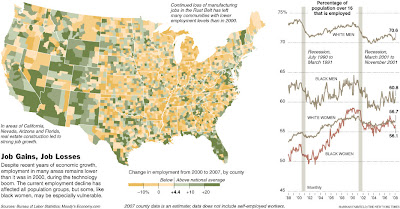
As the presidential contenders Hillary Rodham Clinton and Barack Obama crisscross Ohio ahead of its Democratic primary on Tuesday, they are stopping in many cities on that list — Canton, Cleveland, Dayton, Toledo. They are focusing on bread-and-butter economic issues, promising to increase the minimum wage, extend unemployment benefits and generate new jobs.
Oakland, long known as the blue-collar sibling to the aristocratic San Francisco across the bay, is among the metropolitan areas that never fully recovered from the last recession, with fewer jobs today than in March 2001, according to Economy.com. The technology boom of the 1990s and the real estate bonanza of more recent years created fewer jobs and less wealth here than they did in the moneyed enclaves like Silicon Valley. Yet if Oakland missed out on the festivities, it is already feeling the pullback.
“There’s more competition for every job,” said Gay Plair Cobb, chief executive of the Oakland Private Industry Council, a job training organization. “People are getting discouraged and depressed.”
Home to about 400,000 people, Oakland is enormously diverse, with blacks making up 36 percent of the population, Hispanics 22 percent and Asian-Americans 15 percent, according to the 2000 census. The city is racked by stubborn poverty, with one-fifth of all households living on less than $15,000 in annual income, according to the census.
Given that picture, Oakland reflects a national trend: The weaker labor market is especially pronounced for African-Americans, and black women in particular, a slide that has halted a quarter-century of steady gains.
From 1975 to early 2000, the percentage of African-American women who were employed jumped to 59 percent from 42 percent. Two years later, following a recession, the percentage had dropped to 55 percent. Since then, employment among African-American women has shown little change, reaching 55.7 percent at the end of 2007.
In a recent paper, the Center for Economic and Policy Research asserted that a recession in 2008 would be likely to swell the ranks of the unemployed by 3.2 million to 5.8 million, while raising the unemployment rate among black Americans to 11.3 percent to 15.5 percent, compared with 8.3 percent in 2007.
Nationally, the unemployment rate remains at a historically low level of 4.9 percent, though this does not include people who have given up looking for work.
The slide in employment is occurring at a time when jobs are more important than ever for millions of households headed by African-American women, because welfare changes in the 1990s forced many into the job market to compensate for a loss of public assistance.
“The labor market for low-income women is so poor that it’s almost a hoax,” says Randy Albelda, an economist at the University of Massachusetts in Boston.
For more than a decade, Dorothy Thomas, 49, an African-American and a mother of two, worked as an administrative assistant at various health care centers in Northern California. In her last job, she earned $16 an hour, as well as benefits, she said.
It was never enough to pay all the bills, she said, so she made choices, paying this one, not paying that one, all the while focused on one mission: getting her two daughters through school. She lived in apartments in better neighborhoods, paying more rent than she could afford to ensure that her girls attended better schools.
“I truly bought into the idea that education is the way out of poverty,” Ms. Thomas says. One daughter received a master’s degree in education and is a teacher in Hawaii, she says, and the other is still in college.
But the bills for Ms. Thomas are still coming due. She lost her car in November 2005 after she fell behind on the payments. Unable to drive to work, she lost her job. Since then, she has been unable to find a job.
Several times, she has landed interviews that seemed likely to bring offers, but the jobs required a credit check — a test she cannot pass.
“My credit is just so in shambles,” she told a classroom full of people gathered for a credit counseling session at the Private Industry Council. “More and more jobs are checking your credit. They’re saying that credit is a reflection of your character.”
Ms. Thomas deftly toggles between different modes of speech, from street-smart to receptionist-smooth. But getting to work without transportation and buying clothes for interviews without cash are beyond her abilities.
“Why can’t I get a job?” she asks, her eyes welling with tears. “Is it because of my age? Is it because I’ve gained weight? I’m articulate. I’m a positive thinker. I know how to conduct myself in an office setting. But I’m starting to lose all my confidence.”
Government data show that the labor market has weakened in recent years for nearly every demographic group. Women as well as men; whites, blacks, Hispanics and Asian-Americans; teenagers and the middle-aged; high school graduates and those with college degrees. In terms of employment as a percentage of population, all remain below the level reached before the last recession.
The source of this weakening and what it says about the overall, long-term health of the economy are the subject of fractious debate.
Some economists argue that the labor market has merely settled back to earth after years of ridiculously aggressive investment in technology, which created far more jobs in the 1990s than could be sustained.
“This is a return to normal,” says Robert E. Hall, an economist and senior fellow at the Hoover Institution, a conservative research group at Stanford.
But others conclude that the sluggish job market reflects long-term, systemic forces reshaping the American economy. It represents, they say, the underbelly of the so-called new moderation that has made recessions less frequent and less severe.
Traditionally, the American economy has often expanded in extreme cycles. In periods of growth, companies hire aggressively. When they sense a slowdown, they cut back, laying off workers and curtailing investments, amplifying the ripples of retrenchment. Now, however, companies aim to keep their work forces lean all the time.
AS the American economy boomed in the late 1990s, so did business for the Bartlett Manufacturing Company, a circuit-board maker based in Cary, Ill. By 2000, it had about 200 workers — mostly in blue-collar assembly jobs at its original factory near Chicago, and an additional 50 or so at a new plant in Albuquerque, said the company’s chairman, Douglas S. Bartlett. Most of the positions paid $10 to $11 an hour.
But by late 2001, with the country in recession and many orders flowing to China, business was down two-thirds from the best years. So the company shuttered its Albuquerque factory and laid off more than 100 workers at its Chicago plant, bringing its total work force down to 87.
Business improved slightly in 2004 and 2005 and remained essentially flat over the last two years, but the company hasn’t added workers.
“We improved our process through automation,” Mr. Bartlett says.
If business now deteriorates, he does not expect to shed workers, because he is already down to the minimum needed to keep his plant running.
“When a customer calls, you need to be able to deliver parts in three or four days because, if they could wait longer, they would just go offshore and get it cheaper,” Mr. Bartlett says. “We don’t lay people off at this point. We just reduce hours. We pretty much can’t get any leaner.”
Bartlett Manufacturing’s experience is emblematic of forces at work throughout the economy. An anemic job market is not so much a product of layoffs — which remain relatively few — as it is a result of a sharp pullback in hiring.
In 1994, 30 million people were hired into new and existing private-sector jobs, according to the Labor Department. By 2000, the number of hires had expanded to 34 million. A year later, in the midst of the recession, hiring slackened to 31.6 million, while layoffs winnowed the work force.
In 2003, with the economy again growing, layoffs slowed, but the private sector hired only 29.8 million — a figure that has nudged up only a little in the years since.
Rather than hire and risk having to fire in another downturn, companies added hours for those already on the payroll and relied more on temporary workers, said Mr. McKelvey, the Goldman Sachs economist. Manufacturing companies continued to automate, to squeeze more production out of the same number of workers, while shifting jobs to lower-cost countries like China and Mexico. For lower-skilled workers, that intensifies the competition for the jobs that remain.
“Now, you’re not only competing against the guy next door,” Mr. McKelvey says. “You’re competing against the guy across the water.”
Some economists say the weakness of hiring in recent years may protect those with jobs against the usual impact of a recession: Many companies are so lean that the unemployment rate may not increase much.
“It’s not your grandfather’s recession anymore,” says Jared Bernstein, senior economist at the Economic Policy Institute, a labor-oriented research group in Washington. “You’re probably going to see fewer layoffs, because you just don’t have the traditional model.”
But the same trend suggests that the impacts of the slowdown are likely to be felt deeply for several years, even after the economy resumes a swift expansion, Mr. Bernstein added.
Before 1990, it took an average of 21 months for the economy to add back the jobs shed during a recession, according to an analysis by the Economic Policy Institute and the National Employment Law Project, a worker advocacy group. Yet in the last two recessions, in 1990 and 2001, it took 31 months and 46 months, respectively, for employment levels to recover fully.
In the recessions of the early 1980s and the early 1990s, the ranks of the so-called long-term unemployed — those out of work for 27 weeks or more — jumped to well above 20 percent of all unemployed people. But in both cases, that share eventually settled back to close to 10 percent of the unemployed.
After the 2001 recession, however, the long-term share stayed above 20 percent from the fall of 2002 until the spring of 2005. In the months since, it has never dipped below 16 percent. In January, 18 percent of those unemployed had been without work for at least 27 weeks, according to the Labor Department.
OAKLAND is typical of the lean hiring that has accompanied the winnowing of jobs. In recent decades, Oakland’s once-formidable manufacturing base has hollowed out as the city has lost food processing factories, auto plants and warehouses. Downtown, concrete-floor factories have been turned into chic residential loft spaces.
Yet the Port of Oakland is booming, with dozens of cranes arrayed at the bay’s edge, plucking containers full of cars and electronic products off of ships arriving from Asia, and depositing shipments of produce from the Central Valley of California.
The port has benefited from a surge in American exports. Port officials cite an economic development study showing that jobs connected in some way to their operations — in industries ranging from cargo and trucking to insurance and retail — doubled to more than 28,000 from 2001 to 2005. A planned $800 million expansion would add 7,000 more jobs, said James Kwon, director of the port’s maritime division.
Deborah Acosta, international trade project manager of the Community and Economic Development Agency of Oakland, says, “We’re talking about good-paying jobs that don’t require a college degree.”
So far, the growth at the port has not been enough to compensate for steady erosion of work elsewhere in the city. Since 2001, the metropolitan area has shed 22,000 manufacturing jobs, and thousands more in transportation and warehousing, and professional and business services, according to Economy.com.
For public officials grappling with the social and political impact of long-term joblessness, training has become a mantra.
“The jobs are there, but the people to fill the jobs are not,” says John Garamendi, the lieutenant governor of California. “The current demand for skilled individuals in medical fields, in biotech, for people capable of welding — there’s a demand for these people.”
But all too often, these job-training programs fail to find people the jobs they expect, said Marsha Murrington, vice president for programs at the Unity Council, a nonprofit social service organization that operates a job center in Oakland.
“People are getting training or high degrees in areas that are not supported by the job market,” she complains. “People are looking for those high-paying corporate jobs that aren’t there.”
Greg Bailey, another Oakland resident, is among those who banked on the benefits of job training. Last spring, after 15 years as a truck driver, an installer of household appliances and a warehouse stocker — jobs that left him nursing a bad back and high blood pressure — Mr. Bailey decided to pursue work that was less physically taxing. He enrolled in a government-financed training program to gain the skills needed to work at one of the many biotechnology plants sprouting up in the area.
“It sounded great; the opportunities were almost endless,” said Mr. Bailey, 40, tall, soft-spoken and personable.
A former high school basketball star, Mr. Bailey said he had to turn down several college scholarships when he graduated so he could find a job and support his mother, who was ill, along with his younger brother. Later, he enrolled several times in various college programs, but the demands of being the family’s primary breadwinner left too few hours for schoolwork.
The biotech training program was to be a way to jump ahead, putting him in position to earn $17 to $18 an hour, as well as health benefits, as a warehouse or maintenance worker in an industry that offered other chances for advancement. But despite applying for about 100 jobs over the last six months, he says, he has never been invited to an interview.
Last summer, a month after the course ended, he went to a job center in East Oakland and was surprised to bump into six of his classmates.
“I was like, ‘Oh man, you’re all here too?’ ” Mr. Bailey said. “We all started looking at anything at that point. It was kind of depressing.”
RECENTLY, he began applying for the same types of jobs from which he had hoped to escape. Now, even those jobs seem beyond reach. He did take one warehouse job that started at 5 a.m. and required him to walk two miles to and from work, but he quit in disgust after two weeks. It paid $10 an hour — two-thirds of what he used to make as a truck driver.
He applied for a minimum-wage job at Wal-Mart, but after two interviews the person doing the hiring was fired, he said, and Mr. Bailey was told that he had to start all over — this for a night shift at a store in an area plagued by crime. Disenchanted, he stopped pursuing a career at Wal-Mart.
“I’ll just look for anything now; it doesn’t matter,” he confided on a recent afternoon.
The next day, he accepted a job at a warehouse for $9 an hour.
“It’s just picking up boxes,” he says. “That’s all right. I’ve got to do something.”
The New York Times
By PETER S. GOODMAN
Published: March 2, 2008
OAKLAND, Calif. — NICOLE FLENNAUGH has a college degree, office experience and the modest expectation that, somewhere in this city on the eastern lip of San Francisco Bay, someone will want to hire her.
Nicole Flennaugh, a college graduate, has had a difficult time finding a full-time job nearly two years after she was laid off as a customer service representative.
Greg Bailey of Oakland enrolled in a biotech training program, but he has not been able to find a job in the industry.
But Ms. Flennaugh, 36, a widow, cannot secure steady, decent-paying work to support herself and her two daughters. Nearly two years after she was laid off as a customer service representative at the Educational Testing Service, and even after applying for dozens of full-time jobs, she has been getting by with occasional stints as an office temp.
“You’re used to making $17 an hour with benefits, and now you have to take any job for $8 an hour,” Ms. Flennaugh says. On a recent afternoon, she sat in front of a computer terminal at an employment center in a gritty part of town, scrolling dejectedly through online job listings while sending another batch of applications into the ether.
“I’ve literally sat and cried, but my friends with double degrees are doing worse,” she says. “It’s the economy. It’s really bad.”
Now, it’s getting tougher — particularly for those at the lower rungs of the economic ladder, and especially for African-Americans like Ms. Flennaugh. As the economy slows and perhaps slides deeper into a recession that may already be under way, communities like this — cities that have long struggled with a shortage of jobs — see work becoming scarcer still.
Across the nation, the labor market has been deteriorating. Many companies, long reluctant to add workers, are hunkered down and waiting for improved prospects, engaged in what Ed McKelvey, a senior economist at Goldman Sachs, calls “a hiring strike.” Americans with jobs are taking cuts to their work hours; those without jobs are staying out of work longer, or accepting positions that pay far less than they earned previously.
Teenagers are struggling to land minimum-wage jobs at fast-food restaurants, because those positions are increasingly being filled by adults. And those with poor credit are finding that this can disqualify them from getting a job.
IN many communities, dreams of upward mobility are yielding to despair and the grim realization that the economy — not strong for less-educated workers even when it was growing — may now be shrinking, making it tougher than ever to find a job.
Indeed, the increasingly anemic job market comes on the heels of six years of economic expansion that delivered robust corporate profits but scant job growth. The last recession, in 2001, was followed by a so-called jobless recovery. As the economy resumed growing, payrolls continued to shrink.
Even as job growth accelerated in 2005 and 2006 before slowing last year, it was not enough to return the country to its previous level. Some 62.8 percent of all Americans age 16 and older were employed at the end of last year, down from the peak of 64.6 percent in early 2000, according to the Labor Department.
“The economy never got its groove back after the tech bubble burst,” says Mark Zandi, chief economist at Moody’s Economy.com. “We’re still feeling fallout from the collapse of the tech economy and the accounting scandals. There are still psychological scars for the managers affected. Managers are less interested in taking risks.”
In many metropolitan areas, overall employment remains below levels reached before the last recession; the list includes New York, Chicago, Detroit, Milwaukee and Buffalo, as well as Boulder, Colo.; Spartanburg, S.C.; and Topeka, Kan., according to Economy.com.
Please click on image to enlarge to read...

As the presidential contenders Hillary Rodham Clinton and Barack Obama crisscross Ohio ahead of its Democratic primary on Tuesday, they are stopping in many cities on that list — Canton, Cleveland, Dayton, Toledo. They are focusing on bread-and-butter economic issues, promising to increase the minimum wage, extend unemployment benefits and generate new jobs.
Oakland, long known as the blue-collar sibling to the aristocratic San Francisco across the bay, is among the metropolitan areas that never fully recovered from the last recession, with fewer jobs today than in March 2001, according to Economy.com. The technology boom of the 1990s and the real estate bonanza of more recent years created fewer jobs and less wealth here than they did in the moneyed enclaves like Silicon Valley. Yet if Oakland missed out on the festivities, it is already feeling the pullback.
“There’s more competition for every job,” said Gay Plair Cobb, chief executive of the Oakland Private Industry Council, a job training organization. “People are getting discouraged and depressed.”
Home to about 400,000 people, Oakland is enormously diverse, with blacks making up 36 percent of the population, Hispanics 22 percent and Asian-Americans 15 percent, according to the 2000 census. The city is racked by stubborn poverty, with one-fifth of all households living on less than $15,000 in annual income, according to the census.
Given that picture, Oakland reflects a national trend: The weaker labor market is especially pronounced for African-Americans, and black women in particular, a slide that has halted a quarter-century of steady gains.
From 1975 to early 2000, the percentage of African-American women who were employed jumped to 59 percent from 42 percent. Two years later, following a recession, the percentage had dropped to 55 percent. Since then, employment among African-American women has shown little change, reaching 55.7 percent at the end of 2007.
In a recent paper, the Center for Economic and Policy Research asserted that a recession in 2008 would be likely to swell the ranks of the unemployed by 3.2 million to 5.8 million, while raising the unemployment rate among black Americans to 11.3 percent to 15.5 percent, compared with 8.3 percent in 2007.
Nationally, the unemployment rate remains at a historically low level of 4.9 percent, though this does not include people who have given up looking for work.
The slide in employment is occurring at a time when jobs are more important than ever for millions of households headed by African-American women, because welfare changes in the 1990s forced many into the job market to compensate for a loss of public assistance.
“The labor market for low-income women is so poor that it’s almost a hoax,” says Randy Albelda, an economist at the University of Massachusetts in Boston.
For more than a decade, Dorothy Thomas, 49, an African-American and a mother of two, worked as an administrative assistant at various health care centers in Northern California. In her last job, she earned $16 an hour, as well as benefits, she said.
It was never enough to pay all the bills, she said, so she made choices, paying this one, not paying that one, all the while focused on one mission: getting her two daughters through school. She lived in apartments in better neighborhoods, paying more rent than she could afford to ensure that her girls attended better schools.
“I truly bought into the idea that education is the way out of poverty,” Ms. Thomas says. One daughter received a master’s degree in education and is a teacher in Hawaii, she says, and the other is still in college.
But the bills for Ms. Thomas are still coming due. She lost her car in November 2005 after she fell behind on the payments. Unable to drive to work, she lost her job. Since then, she has been unable to find a job.
Several times, she has landed interviews that seemed likely to bring offers, but the jobs required a credit check — a test she cannot pass.
“My credit is just so in shambles,” she told a classroom full of people gathered for a credit counseling session at the Private Industry Council. “More and more jobs are checking your credit. They’re saying that credit is a reflection of your character.”
Ms. Thomas deftly toggles between different modes of speech, from street-smart to receptionist-smooth. But getting to work without transportation and buying clothes for interviews without cash are beyond her abilities.
“Why can’t I get a job?” she asks, her eyes welling with tears. “Is it because of my age? Is it because I’ve gained weight? I’m articulate. I’m a positive thinker. I know how to conduct myself in an office setting. But I’m starting to lose all my confidence.”
Government data show that the labor market has weakened in recent years for nearly every demographic group. Women as well as men; whites, blacks, Hispanics and Asian-Americans; teenagers and the middle-aged; high school graduates and those with college degrees. In terms of employment as a percentage of population, all remain below the level reached before the last recession.
The source of this weakening and what it says about the overall, long-term health of the economy are the subject of fractious debate.
Some economists argue that the labor market has merely settled back to earth after years of ridiculously aggressive investment in technology, which created far more jobs in the 1990s than could be sustained.
“This is a return to normal,” says Robert E. Hall, an economist and senior fellow at the Hoover Institution, a conservative research group at Stanford.
But others conclude that the sluggish job market reflects long-term, systemic forces reshaping the American economy. It represents, they say, the underbelly of the so-called new moderation that has made recessions less frequent and less severe.
Traditionally, the American economy has often expanded in extreme cycles. In periods of growth, companies hire aggressively. When they sense a slowdown, they cut back, laying off workers and curtailing investments, amplifying the ripples of retrenchment. Now, however, companies aim to keep their work forces lean all the time.
AS the American economy boomed in the late 1990s, so did business for the Bartlett Manufacturing Company, a circuit-board maker based in Cary, Ill. By 2000, it had about 200 workers — mostly in blue-collar assembly jobs at its original factory near Chicago, and an additional 50 or so at a new plant in Albuquerque, said the company’s chairman, Douglas S. Bartlett. Most of the positions paid $10 to $11 an hour.
But by late 2001, with the country in recession and many orders flowing to China, business was down two-thirds from the best years. So the company shuttered its Albuquerque factory and laid off more than 100 workers at its Chicago plant, bringing its total work force down to 87.
Business improved slightly in 2004 and 2005 and remained essentially flat over the last two years, but the company hasn’t added workers.
“We improved our process through automation,” Mr. Bartlett says.
If business now deteriorates, he does not expect to shed workers, because he is already down to the minimum needed to keep his plant running.
“When a customer calls, you need to be able to deliver parts in three or four days because, if they could wait longer, they would just go offshore and get it cheaper,” Mr. Bartlett says. “We don’t lay people off at this point. We just reduce hours. We pretty much can’t get any leaner.”
Bartlett Manufacturing’s experience is emblematic of forces at work throughout the economy. An anemic job market is not so much a product of layoffs — which remain relatively few — as it is a result of a sharp pullback in hiring.
In 1994, 30 million people were hired into new and existing private-sector jobs, according to the Labor Department. By 2000, the number of hires had expanded to 34 million. A year later, in the midst of the recession, hiring slackened to 31.6 million, while layoffs winnowed the work force.
In 2003, with the economy again growing, layoffs slowed, but the private sector hired only 29.8 million — a figure that has nudged up only a little in the years since.
Rather than hire and risk having to fire in another downturn, companies added hours for those already on the payroll and relied more on temporary workers, said Mr. McKelvey, the Goldman Sachs economist. Manufacturing companies continued to automate, to squeeze more production out of the same number of workers, while shifting jobs to lower-cost countries like China and Mexico. For lower-skilled workers, that intensifies the competition for the jobs that remain.
“Now, you’re not only competing against the guy next door,” Mr. McKelvey says. “You’re competing against the guy across the water.”
Some economists say the weakness of hiring in recent years may protect those with jobs against the usual impact of a recession: Many companies are so lean that the unemployment rate may not increase much.
“It’s not your grandfather’s recession anymore,” says Jared Bernstein, senior economist at the Economic Policy Institute, a labor-oriented research group in Washington. “You’re probably going to see fewer layoffs, because you just don’t have the traditional model.”
But the same trend suggests that the impacts of the slowdown are likely to be felt deeply for several years, even after the economy resumes a swift expansion, Mr. Bernstein added.
Before 1990, it took an average of 21 months for the economy to add back the jobs shed during a recession, according to an analysis by the Economic Policy Institute and the National Employment Law Project, a worker advocacy group. Yet in the last two recessions, in 1990 and 2001, it took 31 months and 46 months, respectively, for employment levels to recover fully.
In the recessions of the early 1980s and the early 1990s, the ranks of the so-called long-term unemployed — those out of work for 27 weeks or more — jumped to well above 20 percent of all unemployed people. But in both cases, that share eventually settled back to close to 10 percent of the unemployed.
After the 2001 recession, however, the long-term share stayed above 20 percent from the fall of 2002 until the spring of 2005. In the months since, it has never dipped below 16 percent. In January, 18 percent of those unemployed had been without work for at least 27 weeks, according to the Labor Department.
OAKLAND is typical of the lean hiring that has accompanied the winnowing of jobs. In recent decades, Oakland’s once-formidable manufacturing base has hollowed out as the city has lost food processing factories, auto plants and warehouses. Downtown, concrete-floor factories have been turned into chic residential loft spaces.
Yet the Port of Oakland is booming, with dozens of cranes arrayed at the bay’s edge, plucking containers full of cars and electronic products off of ships arriving from Asia, and depositing shipments of produce from the Central Valley of California.
The port has benefited from a surge in American exports. Port officials cite an economic development study showing that jobs connected in some way to their operations — in industries ranging from cargo and trucking to insurance and retail — doubled to more than 28,000 from 2001 to 2005. A planned $800 million expansion would add 7,000 more jobs, said James Kwon, director of the port’s maritime division.
Deborah Acosta, international trade project manager of the Community and Economic Development Agency of Oakland, says, “We’re talking about good-paying jobs that don’t require a college degree.”
So far, the growth at the port has not been enough to compensate for steady erosion of work elsewhere in the city. Since 2001, the metropolitan area has shed 22,000 manufacturing jobs, and thousands more in transportation and warehousing, and professional and business services, according to Economy.com.
For public officials grappling with the social and political impact of long-term joblessness, training has become a mantra.
“The jobs are there, but the people to fill the jobs are not,” says John Garamendi, the lieutenant governor of California. “The current demand for skilled individuals in medical fields, in biotech, for people capable of welding — there’s a demand for these people.”
But all too often, these job-training programs fail to find people the jobs they expect, said Marsha Murrington, vice president for programs at the Unity Council, a nonprofit social service organization that operates a job center in Oakland.
“People are getting training or high degrees in areas that are not supported by the job market,” she complains. “People are looking for those high-paying corporate jobs that aren’t there.”
Greg Bailey, another Oakland resident, is among those who banked on the benefits of job training. Last spring, after 15 years as a truck driver, an installer of household appliances and a warehouse stocker — jobs that left him nursing a bad back and high blood pressure — Mr. Bailey decided to pursue work that was less physically taxing. He enrolled in a government-financed training program to gain the skills needed to work at one of the many biotechnology plants sprouting up in the area.
“It sounded great; the opportunities were almost endless,” said Mr. Bailey, 40, tall, soft-spoken and personable.
A former high school basketball star, Mr. Bailey said he had to turn down several college scholarships when he graduated so he could find a job and support his mother, who was ill, along with his younger brother. Later, he enrolled several times in various college programs, but the demands of being the family’s primary breadwinner left too few hours for schoolwork.
The biotech training program was to be a way to jump ahead, putting him in position to earn $17 to $18 an hour, as well as health benefits, as a warehouse or maintenance worker in an industry that offered other chances for advancement. But despite applying for about 100 jobs over the last six months, he says, he has never been invited to an interview.
Last summer, a month after the course ended, he went to a job center in East Oakland and was surprised to bump into six of his classmates.
“I was like, ‘Oh man, you’re all here too?’ ” Mr. Bailey said. “We all started looking at anything at that point. It was kind of depressing.”
RECENTLY, he began applying for the same types of jobs from which he had hoped to escape. Now, even those jobs seem beyond reach. He did take one warehouse job that started at 5 a.m. and required him to walk two miles to and from work, but he quit in disgust after two weeks. It paid $10 an hour — two-thirds of what he used to make as a truck driver.
He applied for a minimum-wage job at Wal-Mart, but after two interviews the person doing the hiring was fired, he said, and Mr. Bailey was told that he had to start all over — this for a night shift at a store in an area plagued by crime. Disenchanted, he stopped pursuing a career at Wal-Mart.
“I’ll just look for anything now; it doesn’t matter,” he confided on a recent afternoon.
The next day, he accepted a job at a warehouse for $9 an hour.
“It’s just picking up boxes,” he says. “That’s all right. I’ve got to do something.”
Tuesday, February 26, 2008
The U.S. economy is plumetting even faster than George Bush's popularity in the polls
Economic woes finish off Sharper Image, Lillian Vernon
Ford Is Pushing Buyouts to Workers
A tale of two industries tells the story of where the U.S. economy is headed along with the President's popularity:

Kevin Ford, left, and Troy Marks, right, talk with a job recruiter Friday at the Ford stamping plant in Woodhaven, Mich.
New York Times
February 26, 2008
Ford Is Pushing Buyouts to Workers
By BILL VLASIC
WOODHAVEN, Mich. — The Ford Motor Company is applying the hard sell these days — piling on incentives, doling out marketing DVDs and brochures, and making offers it hopes are too good to pass up.
But Ford’s big new push is not to sell cars. Instead, it is trying to sign up thousands of workers to take buyouts, partly by convincing them that their brightest future lies outside the company that long offered middle-class wages for blue-collar jobs.
So, Ford is pitching a buffet of buyout packages that are easily among the richest ever offered to factory workers, including one-time cash payments of $140,000 or college tuition plans for an entire family.
The automaker is also putting on job fairs in its plants and mailing each of its 54,000 hourly workers a feature-length DVD, titled “Connecting With Your Future,” that extols the promise of new careers beyond the assembly line.
Last Friday, inside a huge sheet-metal stamping plant in this industrial center south of Detroit, Ford workers spent their lunch hour perusing opportunities to go back to school, hire on at growing companies and open fast-food franchises.
“I am taking it seriously, but it’s really hard to think about leaving,” said Jerry Thomas, a 37-year-old millwright with 12 years at Ford. “The only thing that would make me do it is the uncertainty. We just don’t know what’s going to happen with Ford.”
The push to move workers out reflects the tough times in Detroit. Ford has lost $15 billion in the last two years, and General Motors and Chrysler are also revamping after heavy losses.
While Detroit’s Big Three have already cut about 80,000 jobs through buyouts and early retirements since 2006, a new blitz is under way to shrink employment even further to make way for lower-paid workers in the future.
The aggressive approach to buyouts is particularly striking at Ford.
In the early 1900s, the company founder, Henry Ford, transformed the American workplace by pioneering $5-a-day wages on the assembly line. And the company’s paternalistic culture still lingers in the way workers often refer to the company as “Ford’s,” in reference to the family that provided them a comfortable income.
Ford executives say the buyout packages, which are the most lucrative and diverse ever offered in the industry, reflect a belief that Ford should look after its workers and ease their transition into different careers.
“We need to restructure, and it’s important to our business to do so,” said Joseph R. Hinrichs, Ford’s head of global manufacturing. “But we want to do it in the best way for our employees.”
But there is no mistaking Ford’s message that this is the last companywide offer, and there could be layoffs if further downsizing becomes necessary.
Ford is not saying how many workers it expects to take the buyouts by a March 18 deadline. But Wall Street analysts say the company has set a goal to get 8,000 employees to sign up.
General Motors is also extending buyout offers to all of its 74,000 hourly employees, while Chrysler is offering buyouts to workers on a regional and individual plant basis.
The belt-tightening comes after years of declining market share and increased competition from foreign automakers, led by Toyota.
“These companies are trying to do in the last 24 months what they should have done over the last 24 years,” said John A. Casesa of the automotive consulting firm Casesa Shapiro Group. “That’s why it’s such a shock to the system.”
Ford has eliminated more than 32,000 jobs over the last two years through buyouts and early retirements. But it needs to cut more to improve productivity, make room for transfers from its former Visteon parts plants, and pave the way for new hires at wages of $14 an hour — roughly half of current pay scales.
“We always prefer for people to voluntarily leave and that’s why we put the energy and effort into this package of buyouts,” said Martin J. Mulloy, Ford’s vice president for labor affairs.
The buyout deals were developed with the United Automobile Workers union. In fact, one senior union official endorsed the downsizing effort in a cover article titled “Fresh Opportunities” in the company’s internal Ford World magazine.
“Because of the loss of market share and because the economy is so bad, there aren’t enough jobs for everybody,” said the official, Bob King, the U.A.W.’s Ford division vice president.
The company is offering a broad range of buyout and early retirement packages.
Employees with as little as one year of seniority can receive $100,000 cash, although they give up all health benefits after a six-month period. For employees at least 55 years old and with at least 10 years on the job, the payout jumps to $140,000.
Ford, which has a younger work force than G.M., also included many educational options. One buyout offer provides a worker four years of tuition reimbursement up to $15,000 annually, plus health care coverage over that period and a stipend equal to 50 percent of base wages.
At the Woodhaven stamping plant, the 1,142 hourly workers are wrestling with the many choices facing them.
“They want to give people incentive to walk away,” said Jim Irey, who has worked in the plant for 40 years. “It’s the reality of the business, whether you like it or not.”
Another worker, Andy Linko, contrasted the buyout deals to how he fared when his previous job as a steel worker disappeared.
“We never had this type of opportunity when I was in the steel industry,” Mr. Linko said. “We knew for years that the industry was in trouble, and one day the doors just shut.”
The job fair at Woodhaven offered a mix of career prospects, from truck driving to electrician work at the local utility to franchise opportunities at the Little Caesars pizza chain.
One recruiter, Heidi Daniels of DTE Energy, said the plant was a “great opportunity” to find skilled labor. “I’ve heard of offering out-placement assistance, but this is unique,” Ms. Daniels said. “It’s almost unheard-of.”
Ford has also gone to great lengths to promote the promise of life after the auto industry.
In its DVD, Ford employs actors to urge workers to take “the opportunity to step out and try something new.” Various segments of the DVD highlight former Ford workers who have started their own businesses after taking buyouts.
The company does not track the fortunes of all its former employees, but said it was proud of the “success stories” of people who have taken buyouts.
One such worker, Dale Beck, took a $100,000 buyout in 2006 to open a Little Caesars outlet in St. Louis.
“I went from making cars to making pizzas, and it’s turned out pretty well for me,” Mr. Beck said. “I also know some people who took the money and spent it, and now they’re struggling.”
Workers in the Woodhaven plant seem to split among younger workers who see the buyouts as a window to a new life, and older employees who cannot imagine giving up their Ford paychecks.
“I’m taking the $100,000,” said Stacy Haynes, a 34-year-old mother of four children. “I’ve been here 12 years, and I can’t believe I lasted this long.”
Bill Fender, a 58-year-old tool and die maker with 37 years on the job, sees it differently.
“I’d like to retire, but it’s just not enough money for me now,” Mr. Fender said. “I’m making almost $80,000 a year, and I can’t see leaving that behind.”
One thing Ford workers are proud of is that their buyout options are more extensive and, in some instances, better paying than those at G.M.
Those bragging rights seem a poignant commentary on the depth of Detroit’s difficulties, said the historian Douglas Brinkley, author of a book on Ford titled “Wheels for the World.”
“There was a time in the 20th century when you flashed a Ford badge in Detroit and it meant you were a man on the rise,” Mr. Brinkley said. “Now, the new status symbol of the Rust Belt is they are downsizing people better than other companies are.”
**********************
Lillian Vernon Corp. files for bankruptcy protection
Virginia Beach, Virginia

Employees leave Lillian Vernon on Friday, Feb. 15, after layoffs were announced earlier in the day. (Vicki Cronis-Nohe | The Virginian-Pilot)
Creditors holding the largest unsecured claims against Lillian Vernon Corp.:
- Smart Post, Pittsburgh, Pa. - $2.2 million
- Direct Holdings Worldwide, N.Y. - $1.4 million
- Gift (VA) LLC, New York - $1 million
- Federal Express Corp., Pittsburgh - $990,359
- Graphic Communication, Atlanta - $901,101
- Quad Graphics Inc., Atlanta - $830,684
- Li & Fung (Trading) Limited - $604,767
- Linkshare Lockbox , New York - $498,619
- Paradysz Matera, New York - $473,431
- International Paper Co., Pittsburgh - $455,298
By Gregory Richards
The Virginian-Pilot
February 20, 2008
VIRGINIA BEACH
It started in a New York housewife's kitchen 57 years ago. It could end in a Delaware courtroom.
On Wednesday, five days after Lillian Vernon Corp. laid off half its year-round work force, the catalog and Internet retailer filed for Chapter 11 bankruptcy protection in Delaware.
The company, which became a retailing icon by selling low- cost personalized gifts and gadgets, has determined that "a sale or orderly wind down of the debtors' business is in the best interest of all stakeholders," said Robert J. Eveleigh, its chief financial officer, in the bankruptcy filing.
The filing was not a surprise. Last week, the chief executive of Lillian Vernon said the bankruptcy track was a possibility.
"I was very sad to hear the news today," said Lillian Vernon, through her oldest son Fred Hochberg, who spoke with his mother Wednesday. Vernon, 80, founded the company as a newlywed in 1951 and was its chairman when it was sold five years ago.
"The Lillian Vernon company was a great American success story," she said. "Only in America could a young woman immigrant build a public company and a brand known to millions of consumers."
The company asked Wednesday for court approval to hire a liquidator to help it conduct a going-out-of-business sale to pay off debts. T he company already is advertising a sale on its Web site, offering as much as 85 percent off dozens of products.
It also has employed an investment banking firm to explore selling the company, which now has about 189 employees based mostly in Virginia Beach.
Slowing sales and increasing costs over the past decade have led to the bankruptcy, the company said in court documents filed in U.S. Bankruptcy Court in Wilmington, Del. Also contributing were the "significant" quarterly rent payments for its 870,000-square-foot distribution center off Lynnhaven Parkway. Lillian Vernon's headquarters and customer call center are at that site.
An increasingly weak retail environment is proving to be the breaking point not only for Lillian Vernon but other retailers as well. The Sharper Image Corp., another retailer, which has one store in Hampton Roads at MacArthur Center in downtown Norfolk, filed for bankruptcy on Tuesday.
In its filing, Lillian Vernon listed assets and debt of between $1 million and $100 million. It estimates that it owes money to between 5,001 and 10,000 creditors.
Six affiliates of Lillian Vernon - including Lillian Vernon International Ltd., The Corporate Solution Inc. and Rue de France Inc. - also are seeking Chapter 11 bankruptcy protection. Lillian Vernon is asking the court to jointly administer the cases.
Among local companies owed money in a 112-page listing are The Virginian-Pilot, Food Lion store 1333 in Virginia Beach and Forbes Candies Inc.
The 30 largest unsecured creditors are owed $11.6 million. The top four unsecured creditors are Smart Post, which is owed $2.2 million; Direct Holdings Worldwide, a former owner of Lillian Vernon, which is owed $1.4 million; Gift (VA) LLC, $1.1 million; and FedEx Corp., $990,360.
Lillian Vernon also said it owes about $15.5 million to secured lender Wachovia Bank, and roughly $7.5 million to investors.
The company is so crunched for cash that it is unsure whether it will be able to keep its lights on. The retailer is asking the court to prevent utility companies from shutting off electric, gas, sewer, water and telephone/data service. The company's monthly utility bill averages about $130,000, according to the filing.
The company has "insufficient available cash to meet ongoing obligations necessary to run their business, accomplish their business goals and effect their reorganization," Eveleigh wrote. "As a result, the debtors urgently need credit and additional capital to continue their business and operations."
Sun Capital Partners Inc., a Boca Raton, Fla.-based private investment group, bought Lillian Vernon in May 2006. Shortly after the acquisition, the retailer's headquarters was moved from White Plains, N.Y., to the Virginia Beach distribution center that it has operated since 1988. Richard A. Hurwitz, Sun Capital's spokesman, did not return a call for comment Wednesday.
Over the years, Lillian Vernon Corp. grew to become one of Virginia Beach's largest corporate citizens. Vernon gave up control of the then-publicly-held company in 2003, when it was sold to two companies that formed a partnership called Direct Holdings Worldwide.
Recent years have been difficult financially for the retailer. Lillian Vernon has lost money every year since 2000, Michael D. Muoio, its chief executive, said on Friday. It had sales of $156.7 million in its fiscal year that ended in June, he said.
After Muoio took over leadership in June 2006, he pledged to restore the company. Muoio did not return calls for comment Wednesday.
"I told her the day I joined the company that every fiber in my brain and in my body is dedicated to getting her name back to the iconic status it deserves," Muoio said in December 2006, recalling a conversation with the company's founder. "Those were the right words. I think that brought a tear to her eye."
A hearing on the case is scheduled for today at the Delaware bankruptcy court.
Bloomberg News, The Associated Press and staff writers Carolyn Shapiro and Tom Shean contributed to this report.
Gregory Richards, (757) 446-2599, gregory.richards@pilotonline.com
***********************
Lillian Vernon Corporation files for bankruptcy after years of exploiting thousands of workers in Virginia Beach sweatshop
Bankruptcy hits Lillian Vernon, Sharper Image
Weak holiday season and a struggling economy have forced the gadget retailers to file for bankruptcy; Shaper Image hurt by liquidity crisis, tough competition.
EMAIL | PRINT | DIGG | RSS Subscribe to Companies
feed://rss.cnn.com/rss/money_news_companies.rss
Paste this link into your favorite RSS desktop reader
See all CNNMoney.com RSS FEEDS (close) February 20 2008: 10:50 AM EST
Video
More video
New company offers consumers cash for their outdated hardware.
Play video
NEW YORK (AP) -- Troubled retailers Sharper Image Corp. and Lillian Vernon Corp. have filed for bankruptcy, pointing to the effects of a weak holiday season and a struggling economy.
Sharper Image, known for its high-tech novelty gadgets, and Lillian Vernon, which sells low-cost gifts and gadgets through its catalog and Web site, have long been plagued with falling sales.
But an increasingly weak retail environment proved to be the breaking point for the retailers. Consumers have cut back on discretionary spending as credit and housing markets remain weak and high food and gas prices persist.
In an affidavit filed with the U.S. Bankruptcy Court for the District of Delaware on Tuesday, Sharper Image Chief Financial Officer Rebecca L. Roedell said the company has experienced declining sales since 2004 and recorded net losses in fiscal 2005 to 2007, continuing into 2008.
She said the company is in a "severe liquidity crisis," hurt by tougher competition, deteriorating gross margins, pending litigation and the volatile credit and financing markets, among other factors.
A rejected settlement offer related to a class-action lawsuit involving its air purifiers led to a drop in the company's stock price, loss in market confidence and eventually contracted credit terms from vendors and suppliers, Roedell said.
Sharper Image names third CEO in 17 months
San Francisco-based Sharper Image plans to close 90 of its 184 stores as soon as possible after it sells their inventories. It plans to continue to conduct business as usual while it develops a reorganization plan.
Meanwhile, Lillian Vernon Chief Financial Officer Robert J. Eveleigh said in an affidavit Wednesday that the company, which has a highly cyclical business that peaks during the Christmas holidays, has experienced declining sales and rising costs over the past decade.
"During the past holiday season expected sales growth did not occur, which resulted in lower profitability and significant unsold inventory," Eveleigh wrote. "These factors combined to significantly impair (Lillian Vernon's) ability to find additional financing."
The company is evaluating whether it is in the best interest of its shareholders to sell itself or liquidate.
Both companies had recently attempted management changes and other moves to try and help results.
Last week, Sharper Image named a crisis-management expert as its new chief executive, while Lillian Vernon laid off half its year-round work force at its Virginia Beach, Va., distribution center.
Soleil Securities Group Inc. analyst Scott Tilghman said in a note to investors on Wednesday that Sharper Image's filing was not a surprise.
"Sales have simply failed to normalize given the sustained pressure on the company's two core product categories, air purifiers and massage chairs, while macroeconomic pressures have heightened the challenges for the company," he wrote. "The series of management changes over the last couple of years have not stopped the company's poor fundamental performance nor have they materialized in significant strategic changes."
Tilghman, who had rated Sharper Image "Hold," said he was discontinuing coverage of Sharper Image.
"We find no reason for investors to be involved with Sharper Image in the near term," he wrote.
Sharper Image (SHRP) shares lost 71.5% in morning trading on the Nasdaq Wednesday.
*************
Lillian Vernon files for bankruptcy
Chantal Todé
February 21, 2008
On February 19, Lillian Vernon filed for Chapter 11 protection in the District of Delaware, along with several other entities including Lillian Vernon International Inc., LV Catalog Holding Corp., LVC Retail Corp., Everyday Celebrations Inc. and Rue de France Inc.
Lillian Vernon laid off 50% of its workforce on February 15, saying that it is considering strategic alternatives including a possible sale of the company.
The news follows a series of staff reductions and other cutbacks, including a reduction in circulation, over the past year.
When Sun Capital acquired the company in 2006, Lillian Vernon's losses were around $22 million, said Michael Muoio, president/CEO of the company. Merchandising, overhead and other issues were resolved during the following year, reducing losses to $3.9 million. However, increasing paper, postage and freight costs made it impossible for Lillian Vernon to entirely bounce back from its earlier problems.
“The cost increases were impossible to overcome,” Muoio said. The current economic situation hasn't helped, either.
Sun Capital has said it is not going to fund Lillian Vernon going forward. As a result, it is cutting back staff and looking for a potential buyer with the help of investment bank Gruppo, Levey & Co.
“The company will probably be sold in a relatively short period of time,” Muoio told DMNews. Lillian Vernon will consider selling the company in pieces if necessary.
In the mean time, Lillian Vernon will “continue to operate as long as it possibly can,” Muoio said.
****************
More Layoffs, Likely Sale for Lillian Vernon
Feb 15, 2008 3:25 PM , By Jim Tierney
Things have gone from bad to worse for Lillian Vernon. Two months after it cut 25% of its staff, the struggling gifts and housewares cataloger on Feb. 15 laid off about half of its full-time staff, or nearly 200 employees.
The situation is so dire that Lillian Vernon is actively seeking a new owner, says CEO Michael D. Muoio.
The Virginia Beach, VA-based merchant has in fact hired New York-based investment bank Gruppo, Levey & Co. to explore strategic alternatives for Lillian Vernon. “We’re looking at all alternatives in terms of sale of the company,” Muoio says.
Citing devastating increases in postal and parcel rates, coupled with a paper price hikes and a decrease in value of the U.S. dollar, Muoio says the company was left with no alternative than to find a new owner.
And finding a new owner is a top priority. “We’re moving as fast as we possibly can,” Muoio says. “Eighty people have been contacted as potential buyers."
Lillian Vernon has been privately held since Direct Holdings purchased it in 2003. It was sold again to Sun Capital Partners in 2006 and later that year moved operations from White Plains, NY, to Virginia Beach, VA.
Muoio says there is a possibility the company would move after a new owner is found. “We may stay here or we may relocate,” he says. “We can’t handle the infrastructure here. It’s too big.” The mailer currently has a 1 million-sq. ft.- facility.
In the past year, Muoio says the company reduced its EBITDA (earnings before interest, taxes, depreciation and amortization) loss from $22.1 million to $3.9 million, but the cost of rent, utilities, and maintenance accounted for $4.6 million.
“We actually made money on an EBITDA basis,” he says, “but we got whacked in the head with the postal, freight, and paper cost increases. And we started to shrink the business.”
As of June 30, 2007, the company had 564 employees; 374 employees as of Dec. 31, 2007; and it now has 177 employees. Worse yet, Muoio says that more layoffs are possible. “That’s in the cards because we don’t know the future of the company.”
He remains confident about Lillian Vernon’s outlook, however: “It’ll all be Lillian Vernon again.” And he’s proud of the fact that “we managed to get this thing to profitability inside of 12 months.”
Nonetheless, “It’s a sad day here at Lillian Vernon,” Muoio says. “But we’re continuing to operate and are working very hard to find a partner. Something is going to happen. I’m very confident of that. It’s too good of a company to have it stop shipping. We haven’t finished our work here.”
******************
Ford Is Pushing Buyouts to Workers
A tale of two industries tells the story of where the U.S. economy is headed along with the President's popularity:

Kevin Ford, left, and Troy Marks, right, talk with a job recruiter Friday at the Ford stamping plant in Woodhaven, Mich.
New York Times
February 26, 2008
Ford Is Pushing Buyouts to Workers
By BILL VLASIC
WOODHAVEN, Mich. — The Ford Motor Company is applying the hard sell these days — piling on incentives, doling out marketing DVDs and brochures, and making offers it hopes are too good to pass up.
But Ford’s big new push is not to sell cars. Instead, it is trying to sign up thousands of workers to take buyouts, partly by convincing them that their brightest future lies outside the company that long offered middle-class wages for blue-collar jobs.
So, Ford is pitching a buffet of buyout packages that are easily among the richest ever offered to factory workers, including one-time cash payments of $140,000 or college tuition plans for an entire family.
The automaker is also putting on job fairs in its plants and mailing each of its 54,000 hourly workers a feature-length DVD, titled “Connecting With Your Future,” that extols the promise of new careers beyond the assembly line.
Last Friday, inside a huge sheet-metal stamping plant in this industrial center south of Detroit, Ford workers spent their lunch hour perusing opportunities to go back to school, hire on at growing companies and open fast-food franchises.
“I am taking it seriously, but it’s really hard to think about leaving,” said Jerry Thomas, a 37-year-old millwright with 12 years at Ford. “The only thing that would make me do it is the uncertainty. We just don’t know what’s going to happen with Ford.”
The push to move workers out reflects the tough times in Detroit. Ford has lost $15 billion in the last two years, and General Motors and Chrysler are also revamping after heavy losses.
While Detroit’s Big Three have already cut about 80,000 jobs through buyouts and early retirements since 2006, a new blitz is under way to shrink employment even further to make way for lower-paid workers in the future.
The aggressive approach to buyouts is particularly striking at Ford.
In the early 1900s, the company founder, Henry Ford, transformed the American workplace by pioneering $5-a-day wages on the assembly line. And the company’s paternalistic culture still lingers in the way workers often refer to the company as “Ford’s,” in reference to the family that provided them a comfortable income.
Ford executives say the buyout packages, which are the most lucrative and diverse ever offered in the industry, reflect a belief that Ford should look after its workers and ease their transition into different careers.
“We need to restructure, and it’s important to our business to do so,” said Joseph R. Hinrichs, Ford’s head of global manufacturing. “But we want to do it in the best way for our employees.”
But there is no mistaking Ford’s message that this is the last companywide offer, and there could be layoffs if further downsizing becomes necessary.
Ford is not saying how many workers it expects to take the buyouts by a March 18 deadline. But Wall Street analysts say the company has set a goal to get 8,000 employees to sign up.
General Motors is also extending buyout offers to all of its 74,000 hourly employees, while Chrysler is offering buyouts to workers on a regional and individual plant basis.
The belt-tightening comes after years of declining market share and increased competition from foreign automakers, led by Toyota.
“These companies are trying to do in the last 24 months what they should have done over the last 24 years,” said John A. Casesa of the automotive consulting firm Casesa Shapiro Group. “That’s why it’s such a shock to the system.”
Ford has eliminated more than 32,000 jobs over the last two years through buyouts and early retirements. But it needs to cut more to improve productivity, make room for transfers from its former Visteon parts plants, and pave the way for new hires at wages of $14 an hour — roughly half of current pay scales.
“We always prefer for people to voluntarily leave and that’s why we put the energy and effort into this package of buyouts,” said Martin J. Mulloy, Ford’s vice president for labor affairs.
The buyout deals were developed with the United Automobile Workers union. In fact, one senior union official endorsed the downsizing effort in a cover article titled “Fresh Opportunities” in the company’s internal Ford World magazine.
“Because of the loss of market share and because the economy is so bad, there aren’t enough jobs for everybody,” said the official, Bob King, the U.A.W.’s Ford division vice president.
The company is offering a broad range of buyout and early retirement packages.
Employees with as little as one year of seniority can receive $100,000 cash, although they give up all health benefits after a six-month period. For employees at least 55 years old and with at least 10 years on the job, the payout jumps to $140,000.
Ford, which has a younger work force than G.M., also included many educational options. One buyout offer provides a worker four years of tuition reimbursement up to $15,000 annually, plus health care coverage over that period and a stipend equal to 50 percent of base wages.
At the Woodhaven stamping plant, the 1,142 hourly workers are wrestling with the many choices facing them.
“They want to give people incentive to walk away,” said Jim Irey, who has worked in the plant for 40 years. “It’s the reality of the business, whether you like it or not.”
Another worker, Andy Linko, contrasted the buyout deals to how he fared when his previous job as a steel worker disappeared.
“We never had this type of opportunity when I was in the steel industry,” Mr. Linko said. “We knew for years that the industry was in trouble, and one day the doors just shut.”
The job fair at Woodhaven offered a mix of career prospects, from truck driving to electrician work at the local utility to franchise opportunities at the Little Caesars pizza chain.
One recruiter, Heidi Daniels of DTE Energy, said the plant was a “great opportunity” to find skilled labor. “I’ve heard of offering out-placement assistance, but this is unique,” Ms. Daniels said. “It’s almost unheard-of.”
Ford has also gone to great lengths to promote the promise of life after the auto industry.
In its DVD, Ford employs actors to urge workers to take “the opportunity to step out and try something new.” Various segments of the DVD highlight former Ford workers who have started their own businesses after taking buyouts.
The company does not track the fortunes of all its former employees, but said it was proud of the “success stories” of people who have taken buyouts.
One such worker, Dale Beck, took a $100,000 buyout in 2006 to open a Little Caesars outlet in St. Louis.
“I went from making cars to making pizzas, and it’s turned out pretty well for me,” Mr. Beck said. “I also know some people who took the money and spent it, and now they’re struggling.”
Workers in the Woodhaven plant seem to split among younger workers who see the buyouts as a window to a new life, and older employees who cannot imagine giving up their Ford paychecks.
“I’m taking the $100,000,” said Stacy Haynes, a 34-year-old mother of four children. “I’ve been here 12 years, and I can’t believe I lasted this long.”
Bill Fender, a 58-year-old tool and die maker with 37 years on the job, sees it differently.
“I’d like to retire, but it’s just not enough money for me now,” Mr. Fender said. “I’m making almost $80,000 a year, and I can’t see leaving that behind.”
One thing Ford workers are proud of is that their buyout options are more extensive and, in some instances, better paying than those at G.M.
Those bragging rights seem a poignant commentary on the depth of Detroit’s difficulties, said the historian Douglas Brinkley, author of a book on Ford titled “Wheels for the World.”
“There was a time in the 20th century when you flashed a Ford badge in Detroit and it meant you were a man on the rise,” Mr. Brinkley said. “Now, the new status symbol of the Rust Belt is they are downsizing people better than other companies are.”
**********************
Lillian Vernon Corp. files for bankruptcy protection
Virginia Beach, Virginia

Employees leave Lillian Vernon on Friday, Feb. 15, after layoffs were announced earlier in the day. (Vicki Cronis-Nohe | The Virginian-Pilot)
Creditors holding the largest unsecured claims against Lillian Vernon Corp.:
- Smart Post, Pittsburgh, Pa. - $2.2 million
- Direct Holdings Worldwide, N.Y. - $1.4 million
- Gift (VA) LLC, New York - $1 million
- Federal Express Corp., Pittsburgh - $990,359
- Graphic Communication, Atlanta - $901,101
- Quad Graphics Inc., Atlanta - $830,684
- Li & Fung (Trading) Limited - $604,767
- Linkshare Lockbox , New York - $498,619
- Paradysz Matera, New York - $473,431
- International Paper Co., Pittsburgh - $455,298
By Gregory Richards
The Virginian-Pilot
February 20, 2008
VIRGINIA BEACH
It started in a New York housewife's kitchen 57 years ago. It could end in a Delaware courtroom.
On Wednesday, five days after Lillian Vernon Corp. laid off half its year-round work force, the catalog and Internet retailer filed for Chapter 11 bankruptcy protection in Delaware.
The company, which became a retailing icon by selling low- cost personalized gifts and gadgets, has determined that "a sale or orderly wind down of the debtors' business is in the best interest of all stakeholders," said Robert J. Eveleigh, its chief financial officer, in the bankruptcy filing.
The filing was not a surprise. Last week, the chief executive of Lillian Vernon said the bankruptcy track was a possibility.
"I was very sad to hear the news today," said Lillian Vernon, through her oldest son Fred Hochberg, who spoke with his mother Wednesday. Vernon, 80, founded the company as a newlywed in 1951 and was its chairman when it was sold five years ago.
"The Lillian Vernon company was a great American success story," she said. "Only in America could a young woman immigrant build a public company and a brand known to millions of consumers."
The company asked Wednesday for court approval to hire a liquidator to help it conduct a going-out-of-business sale to pay off debts. T he company already is advertising a sale on its Web site, offering as much as 85 percent off dozens of products.
It also has employed an investment banking firm to explore selling the company, which now has about 189 employees based mostly in Virginia Beach.
Slowing sales and increasing costs over the past decade have led to the bankruptcy, the company said in court documents filed in U.S. Bankruptcy Court in Wilmington, Del. Also contributing were the "significant" quarterly rent payments for its 870,000-square-foot distribution center off Lynnhaven Parkway. Lillian Vernon's headquarters and customer call center are at that site.
An increasingly weak retail environment is proving to be the breaking point not only for Lillian Vernon but other retailers as well. The Sharper Image Corp., another retailer, which has one store in Hampton Roads at MacArthur Center in downtown Norfolk, filed for bankruptcy on Tuesday.
In its filing, Lillian Vernon listed assets and debt of between $1 million and $100 million. It estimates that it owes money to between 5,001 and 10,000 creditors.
Six affiliates of Lillian Vernon - including Lillian Vernon International Ltd., The Corporate Solution Inc. and Rue de France Inc. - also are seeking Chapter 11 bankruptcy protection. Lillian Vernon is asking the court to jointly administer the cases.
Among local companies owed money in a 112-page listing are The Virginian-Pilot, Food Lion store 1333 in Virginia Beach and Forbes Candies Inc.
The 30 largest unsecured creditors are owed $11.6 million. The top four unsecured creditors are Smart Post, which is owed $2.2 million; Direct Holdings Worldwide, a former owner of Lillian Vernon, which is owed $1.4 million; Gift (VA) LLC, $1.1 million; and FedEx Corp., $990,360.
Lillian Vernon also said it owes about $15.5 million to secured lender Wachovia Bank, and roughly $7.5 million to investors.
The company is so crunched for cash that it is unsure whether it will be able to keep its lights on. The retailer is asking the court to prevent utility companies from shutting off electric, gas, sewer, water and telephone/data service. The company's monthly utility bill averages about $130,000, according to the filing.
The company has "insufficient available cash to meet ongoing obligations necessary to run their business, accomplish their business goals and effect their reorganization," Eveleigh wrote. "As a result, the debtors urgently need credit and additional capital to continue their business and operations."
Sun Capital Partners Inc., a Boca Raton, Fla.-based private investment group, bought Lillian Vernon in May 2006. Shortly after the acquisition, the retailer's headquarters was moved from White Plains, N.Y., to the Virginia Beach distribution center that it has operated since 1988. Richard A. Hurwitz, Sun Capital's spokesman, did not return a call for comment Wednesday.
Over the years, Lillian Vernon Corp. grew to become one of Virginia Beach's largest corporate citizens. Vernon gave up control of the then-publicly-held company in 2003, when it was sold to two companies that formed a partnership called Direct Holdings Worldwide.
Recent years have been difficult financially for the retailer. Lillian Vernon has lost money every year since 2000, Michael D. Muoio, its chief executive, said on Friday. It had sales of $156.7 million in its fiscal year that ended in June, he said.
After Muoio took over leadership in June 2006, he pledged to restore the company. Muoio did not return calls for comment Wednesday.
"I told her the day I joined the company that every fiber in my brain and in my body is dedicated to getting her name back to the iconic status it deserves," Muoio said in December 2006, recalling a conversation with the company's founder. "Those were the right words. I think that brought a tear to her eye."
A hearing on the case is scheduled for today at the Delaware bankruptcy court.
Bloomberg News, The Associated Press and staff writers Carolyn Shapiro and Tom Shean contributed to this report.
Gregory Richards, (757) 446-2599, gregory.richards@pilotonline.com
***********************
Lillian Vernon Corporation files for bankruptcy after years of exploiting thousands of workers in Virginia Beach sweatshop
Bankruptcy hits Lillian Vernon, Sharper Image
Weak holiday season and a struggling economy have forced the gadget retailers to file for bankruptcy; Shaper Image hurt by liquidity crisis, tough competition.
EMAIL | PRINT | DIGG | RSS Subscribe to Companies
feed://rss.cnn.com/rss/money_news_companies.rss
Paste this link into your favorite RSS desktop reader
See all CNNMoney.com RSS FEEDS (close) February 20 2008: 10:50 AM EST
Video
More video
New company offers consumers cash for their outdated hardware.
Play video
NEW YORK (AP) -- Troubled retailers Sharper Image Corp. and Lillian Vernon Corp. have filed for bankruptcy, pointing to the effects of a weak holiday season and a struggling economy.
Sharper Image, known for its high-tech novelty gadgets, and Lillian Vernon, which sells low-cost gifts and gadgets through its catalog and Web site, have long been plagued with falling sales.
But an increasingly weak retail environment proved to be the breaking point for the retailers. Consumers have cut back on discretionary spending as credit and housing markets remain weak and high food and gas prices persist.
In an affidavit filed with the U.S. Bankruptcy Court for the District of Delaware on Tuesday, Sharper Image Chief Financial Officer Rebecca L. Roedell said the company has experienced declining sales since 2004 and recorded net losses in fiscal 2005 to 2007, continuing into 2008.
She said the company is in a "severe liquidity crisis," hurt by tougher competition, deteriorating gross margins, pending litigation and the volatile credit and financing markets, among other factors.
A rejected settlement offer related to a class-action lawsuit involving its air purifiers led to a drop in the company's stock price, loss in market confidence and eventually contracted credit terms from vendors and suppliers, Roedell said.
Sharper Image names third CEO in 17 months
San Francisco-based Sharper Image plans to close 90 of its 184 stores as soon as possible after it sells their inventories. It plans to continue to conduct business as usual while it develops a reorganization plan.
Meanwhile, Lillian Vernon Chief Financial Officer Robert J. Eveleigh said in an affidavit Wednesday that the company, which has a highly cyclical business that peaks during the Christmas holidays, has experienced declining sales and rising costs over the past decade.
"During the past holiday season expected sales growth did not occur, which resulted in lower profitability and significant unsold inventory," Eveleigh wrote. "These factors combined to significantly impair (Lillian Vernon's) ability to find additional financing."
The company is evaluating whether it is in the best interest of its shareholders to sell itself or liquidate.
Both companies had recently attempted management changes and other moves to try and help results.
Last week, Sharper Image named a crisis-management expert as its new chief executive, while Lillian Vernon laid off half its year-round work force at its Virginia Beach, Va., distribution center.
Soleil Securities Group Inc. analyst Scott Tilghman said in a note to investors on Wednesday that Sharper Image's filing was not a surprise.
"Sales have simply failed to normalize given the sustained pressure on the company's two core product categories, air purifiers and massage chairs, while macroeconomic pressures have heightened the challenges for the company," he wrote. "The series of management changes over the last couple of years have not stopped the company's poor fundamental performance nor have they materialized in significant strategic changes."
Tilghman, who had rated Sharper Image "Hold," said he was discontinuing coverage of Sharper Image.
"We find no reason for investors to be involved with Sharper Image in the near term," he wrote.
Sharper Image (SHRP) shares lost 71.5% in morning trading on the Nasdaq Wednesday.
*************
Lillian Vernon files for bankruptcy
Chantal Todé
February 21, 2008
On February 19, Lillian Vernon filed for Chapter 11 protection in the District of Delaware, along with several other entities including Lillian Vernon International Inc., LV Catalog Holding Corp., LVC Retail Corp., Everyday Celebrations Inc. and Rue de France Inc.
Lillian Vernon laid off 50% of its workforce on February 15, saying that it is considering strategic alternatives including a possible sale of the company.
The news follows a series of staff reductions and other cutbacks, including a reduction in circulation, over the past year.
When Sun Capital acquired the company in 2006, Lillian Vernon's losses were around $22 million, said Michael Muoio, president/CEO of the company. Merchandising, overhead and other issues were resolved during the following year, reducing losses to $3.9 million. However, increasing paper, postage and freight costs made it impossible for Lillian Vernon to entirely bounce back from its earlier problems.
“The cost increases were impossible to overcome,” Muoio said. The current economic situation hasn't helped, either.
Sun Capital has said it is not going to fund Lillian Vernon going forward. As a result, it is cutting back staff and looking for a potential buyer with the help of investment bank Gruppo, Levey & Co.
“The company will probably be sold in a relatively short period of time,” Muoio told DMNews. Lillian Vernon will consider selling the company in pieces if necessary.
In the mean time, Lillian Vernon will “continue to operate as long as it possibly can,” Muoio said.
****************
More Layoffs, Likely Sale for Lillian Vernon
Feb 15, 2008 3:25 PM , By Jim Tierney
Things have gone from bad to worse for Lillian Vernon. Two months after it cut 25% of its staff, the struggling gifts and housewares cataloger on Feb. 15 laid off about half of its full-time staff, or nearly 200 employees.
The situation is so dire that Lillian Vernon is actively seeking a new owner, says CEO Michael D. Muoio.
The Virginia Beach, VA-based merchant has in fact hired New York-based investment bank Gruppo, Levey & Co. to explore strategic alternatives for Lillian Vernon. “We’re looking at all alternatives in terms of sale of the company,” Muoio says.
Citing devastating increases in postal and parcel rates, coupled with a paper price hikes and a decrease in value of the U.S. dollar, Muoio says the company was left with no alternative than to find a new owner.
And finding a new owner is a top priority. “We’re moving as fast as we possibly can,” Muoio says. “Eighty people have been contacted as potential buyers."
Lillian Vernon has been privately held since Direct Holdings purchased it in 2003. It was sold again to Sun Capital Partners in 2006 and later that year moved operations from White Plains, NY, to Virginia Beach, VA.
Muoio says there is a possibility the company would move after a new owner is found. “We may stay here or we may relocate,” he says. “We can’t handle the infrastructure here. It’s too big.” The mailer currently has a 1 million-sq. ft.- facility.
In the past year, Muoio says the company reduced its EBITDA (earnings before interest, taxes, depreciation and amortization) loss from $22.1 million to $3.9 million, but the cost of rent, utilities, and maintenance accounted for $4.6 million.
“We actually made money on an EBITDA basis,” he says, “but we got whacked in the head with the postal, freight, and paper cost increases. And we started to shrink the business.”
As of June 30, 2007, the company had 564 employees; 374 employees as of Dec. 31, 2007; and it now has 177 employees. Worse yet, Muoio says that more layoffs are possible. “That’s in the cards because we don’t know the future of the company.”
He remains confident about Lillian Vernon’s outlook, however: “It’ll all be Lillian Vernon again.” And he’s proud of the fact that “we managed to get this thing to profitability inside of 12 months.”
Nonetheless, “It’s a sad day here at Lillian Vernon,” Muoio says. “But we’re continuing to operate and are working very hard to find a partner. Something is going to happen. I’m very confident of that. It’s too good of a company to have it stop shipping. We haven’t finished our work here.”
******************
Saturday, February 2, 2008
2008: The Demise of Neoliberal Globalization
About a year ago while making a presentation to a little Marxist discussion group in Biwabik, Minnesota on the Iron Range among rank and file USW activists I started blowing bubbles using these bottles of bubble solution and a little ring on a wand that you see kids blowing into making bubbles as I was talking about what I thought was going on with the capitalist economy… everyone wondered what the heck I was doing as I poked and popped the bubbles as they began to rise… I am glad to see a major theoretician of the anti-globalization movement talking about bubbles being pricked.
I would urge everyone to contemplate Wallerstein’s concluding question:
And are we now in for more violent chaos in the world-economy and therefore in the world-system as a whole?
I am encouraging people to begin reading three very important publications:
Superprofits and Crisis: Modern U.S. Capitalism by Victor Perlo
Always Bring A Crowd; The Story of Frank Lumpkin, Steelworker by Beatrice Lumpkin
Working Class USA; The Power and the Movement by Gus Hall
Unless working people get up to speed real fast on this “bubble” deal we are going to be in for a real scary ride. There is a reason all the Canadian Provincial Premiers and their Finance Ministers were called in to a top secret meeting where they were all pledged to secrecy a couple weeks ago with the only topic on their agenda the U.S. Economy.
You might consider printing this off and using this as the basis of discussion with family, friends, fellow workers and activists.
Get yourself a little plastic containers of “Bubbles” to get the point across.
Anyways, read what Wallerstein has to say…
by Immanuel Wallerstein
Commentary No. 226, Feb. 1, 2008
"2008: The Demise of Neoliberal Globalization"
The ideology of neoliberal globalization has been on a roll since the early 1980s. It was not in fact a new idea in the history of the modern world-system, although it claimed to be one. It was rather the very old idea that the governments of the world should get out of the way of large, efficient enterprises in their efforts to prevail in the world market. The first policy implication was that governments, all governments, should permit these corporations freely to cross every frontier with their goods and their capital. The second policy implication was that the governments, all governments, should renounce any role as owners themselves of these productive enterprises, privatizing whatever they own. And the third policy implication was that governments, all governments, should minimize, if not eliminate, any and all kinds of social welfare transfer payments to their populations. This old idea had always been cyclically in fashion.
In the 1980s, these ideas were proposed as a counterview to the equally old Keynesian and/or socialist views that had been prevailing in most countries around the world: that economies should be mixed (state plus private enterprises); that governments should protect their citizens from the depredations of foreign-owned quasi-monopolist corporations; and that governments should try to equalize life chances by transferring benefits to their less well-off residents (especially education, health, and lifetime guarantees of income levels), which required of course taxation of better-off residents and corporate enterprises.
The program of neoliberal globalization took advantage of the worldwide profit stagnation that began after a long period of unprecedented global expansion in the post-1945 period up to the beginning of the 1970s, which had encouraged the Keynesian and/or socialist views to dominate policy. The profit stagnation created balance-of-payments problems for a very large number of the world's governments, especially in the global South and the so-called socialist bloc of nations. The neoliberal counteroffensive was led by the right-wing governments of the United States and Great Britain (Reagan and Thatcher) plus the two main intergovernmental financial agencies - the International Monetary Fund and the World Bank, and these jointly created and enforced what came to be called the Washington Consensus. The slogan of this global joint policy was coined by Mrs. Thatcher: TINA, or There is No Alternative. The slogan was intended to convey to all governments that they had to fall in line with the policy recommendations, or they would be punished by slow growth and the refusal of international assistance in any difficulties they might face.
The Washington Consensus promised renewed economic growth to everyone and a way out of the global profit stagnation. Politically, the proponents of neoliberal globalization were highly successful. Government after government - in the global South, in the socialist bloc, and in the strong Western countries - privatized industries, opened their frontiers to trade and financial transactions, and cut back on the welfare state. Socialist ideas, even Keynesian ideas, were largely discredited in public opinion and renounced by political elites. The most dramatic visible consequence was the fall of the Communist regimes in east-central Europe and the former Soviet Union plus the adoption of a market-friendly policy by still-nominally socialist China.
The only problem with this great political success was that it was not matched by economic success. The profit stagnation in industrial enterprises worldwide continued. The surge upward of the stock markets everywhere was based not on productive profits but largely on speculative financial manipulations. The distribution of income worldwide and within countries became very skewed - a massive increase in the income of the top 10% and especially of the top 1% of the world's populations, but a decline in real income of much of the rest of the world's populations.
Disillusionment with the glories of an unrestrained "market" began to set in by the mid-1990s. This could be seen in many developments: the return to power of more social-welfare-oriented governments in many countries; the turn back to calling for government protectionist policies, especially by labor movements and organizations of rural workers; the worldwide growth of an alterglobalization movement whose slogan was "another world is possible."
This political reaction grew slowly but steadily. Meanwhile, the proponents of neoliberal globalization not only persisted but increased their pressure with the regime of George W. Bush. Bush's government pushed simultaneously more distorted income distribution (via very large tax cuts for the very well-off) and a foreign policy of unilateral macho militarism (the Iraq invasion). It financed this by a fantastic expansion of borrowing (indebtedness) via the sale of U.S. treasury bonds to the controllers of world energy supplies and low-cost production facilities.
It looked good on paper, if all one read were the figures on the stock markets. But it was a super-credit bubble that was bound to burst, and is now bursting. The Iraq invasion (plus Afghanistan plus Pakistan) are proving a great military and political fiasco. The economic solidity of the United States has been discredited, causing a radical fall in the dollar. And the stock markets of the world are trembling as they face the pricking of the bubble.
So what are the policy conclusions that governments and populations are drawing? There seem to be four in the offing. The first is the end of the role of the U.S. dollar as the reserve currency of the world, which renders impossible the continuance of the policy of super-indebtedness of both the government of the United States and its consumers. The second is the return to a high degree of protectionism, both in the global North and the global South. The third is the return of state acquisition of failing enterprises and the implementation of Keynesian measures. The last is the return of more social-welfare redistributive policies.
The political balance is swinging back. Neoliberal globalization will be written about ten years from now as a cyclical swing in the history of the capitalist world-economy. The real question is not whether this phase is over but whether the swing back will be able, as in the past, to restore a state of relative equilibrium in the world-system. Or has too much damage been done? And are we now in for more violent chaos in the world-economy and therefore in the world-system as a whole?
Subscribe to:
Posts (Atom)